System Config
- Graphics Card: AMD Radeon RX 9070 XT
- CPU: AMD Ryzen 7 9800X3D
- Launcher: Steam
- Graphics Driver: mesa 1:25.3.2-2
- Driver: 6.18.2-3-cachyos
Saul of Tarsus – Bible Game drops you into the sandals of Saul as he prepares for his journey to Damascus to continue his campaign against Christians. It’s not long into the game before Saul’s conversion occurs, and your mission changes from persecuting Christians to discipling Christians. You’ll navigate and debate your way through events inspired by the book of Acts, in an effort to spread the gospel and undermine the Pharisaical grip on the region.
Once you launch a new game, you’re eased in with a gentle introduction that helps you get comfortable with exploring settlements and interacting with the locals. You’ll need to run some basic errands and procure some water rations for your travels, then you’ll proceed on the road to Damascus. You’ll only be in the opening settlement for about 5-10 mins, and you aren’t required to perform any unpleasant acts during your time as Saul the pharisee. You get your bearings, and head off on your way to Damascus, where you’ll spend the majority of your play time.
If you’ve read the book of Acts, you’ll know that it was on the road to Damascus that God miraculously softened Saul’s heart and opened his eyes to accept the truth that Jesus is indeed the King of kings and Lord of lords. This pivotal encounter takes place as a brief cutscene, and it’s handled with appropriate restraint. Jesus’ familiar words appear on screen without depicting Him physically, and the scene, though over pretty quickly, maintains reverence throughout.
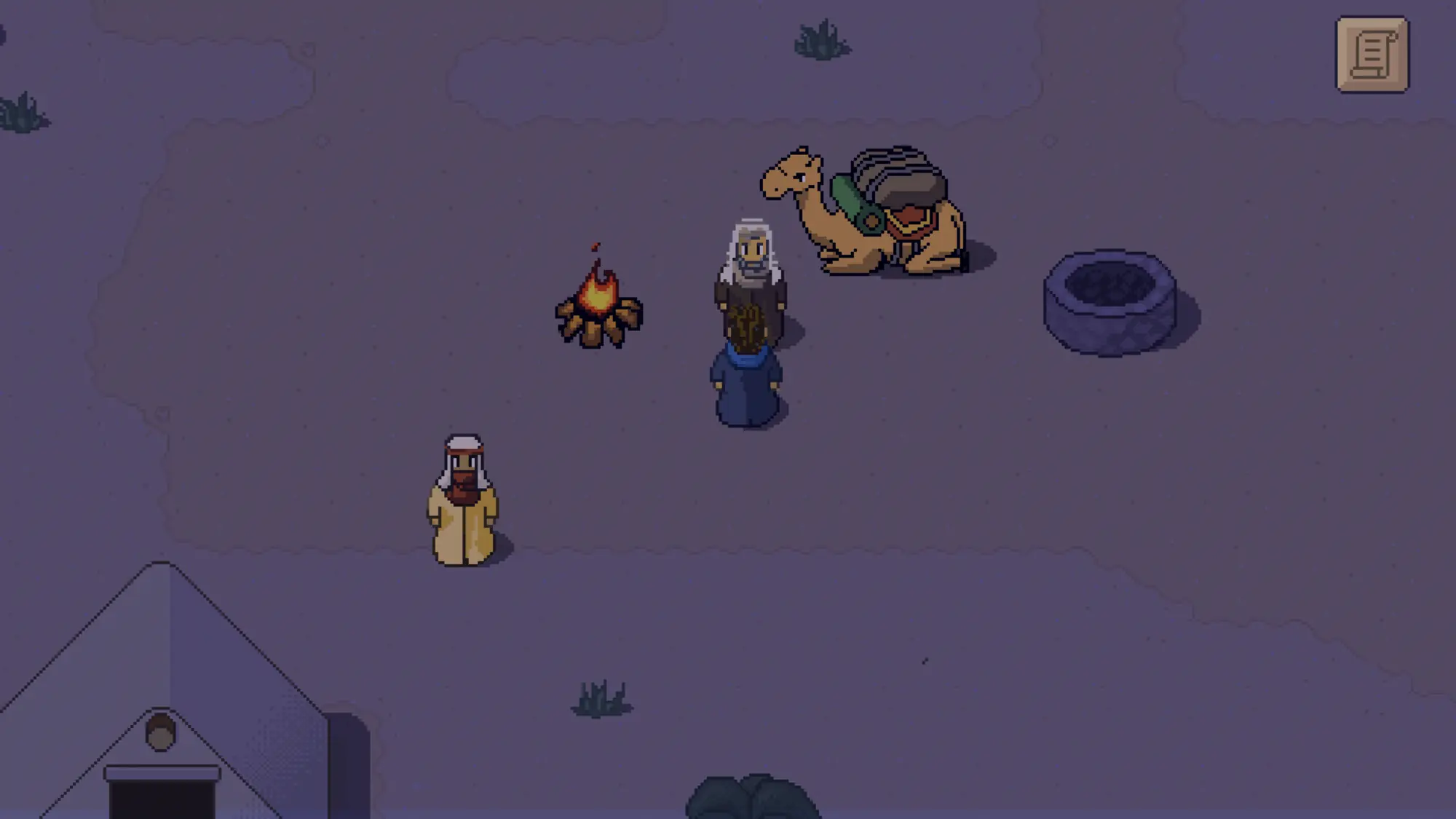
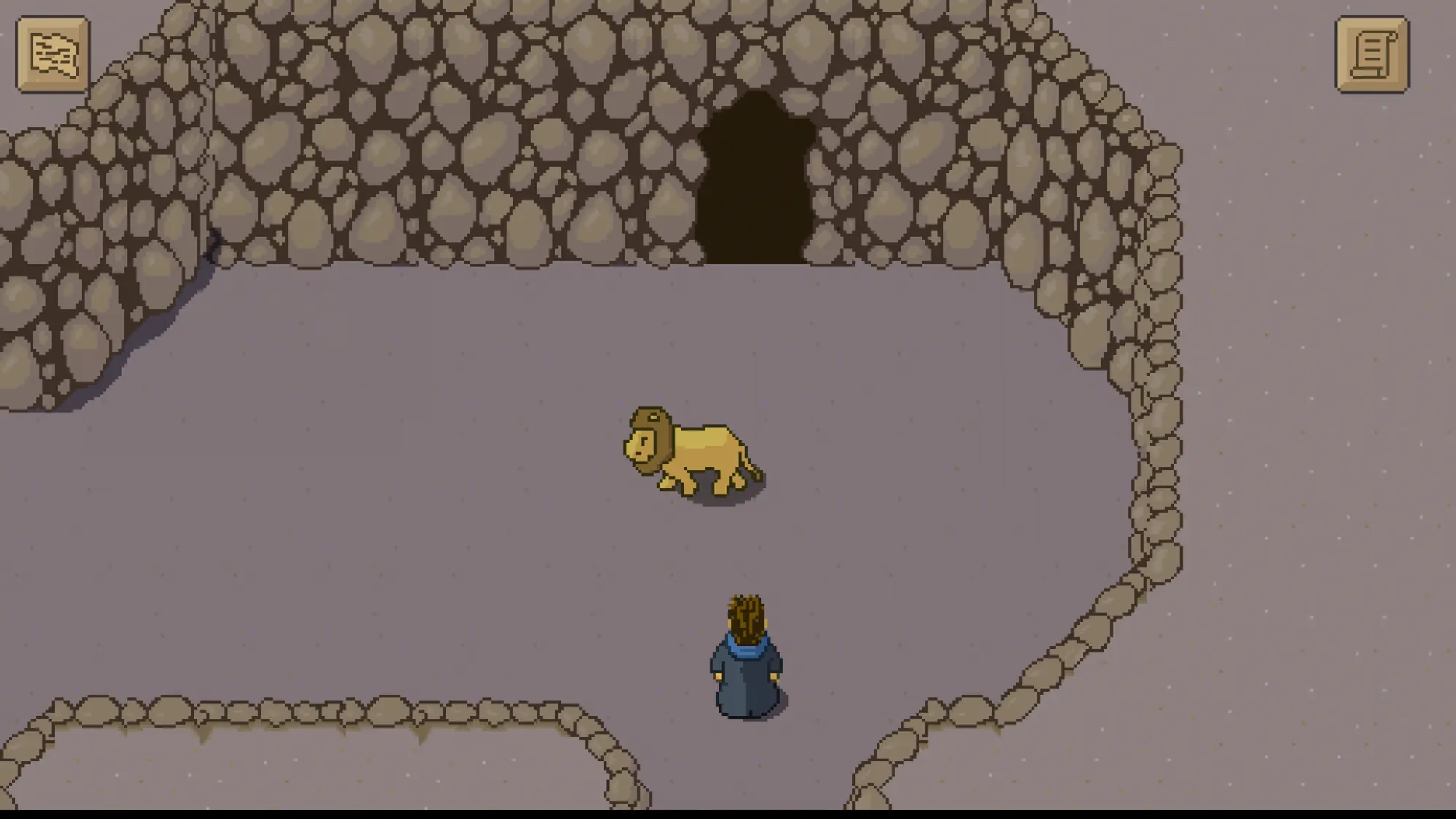
It’s at this point, about 15-20 minutes into the game, that you arrive in Damascus and are now controlling the newly converted Saul who has renounced his Pharisaical ways. It’s here where the training wheels come off and you’re allowed to free roam the city and nearby hot spots. You’re free to follow the main story or partake in some side quests. If you opt to branch off and do your own thing, you’ll explore narrow streets, dangerous deserts, and underground tunnels – all in the name of virtual evangelism.
The pixel art aesthetic is pulled off well, with a charming SNES-era quality about them. From the wandering citizens to the neatly furnished houses, every pixel is putting in the work. There are recycled character assets and palette swaps here and there, sure, but it never became a major distraction for me. I can only recall one instance where I interacted with two completely different people in quick succession whom shared the same portrait art, anyway.
The gameplay loop centres on exploration, fulfilling errands, and engaging in a turn-based debate system that substitutes swords for rhetoric. In combat, rather than depleting health bars, you chip away at your opponent’s resolve through persuasion and the unleashing of special abilities. It’s one-on-one intellectual sparring that blends the battle styles of early Pokémon games with a smidge of Undertale, but with a twist that fits the biblical setting well. You’re not harming anyone physically – you’re debating them into conceding the point. And it works quite well in its simplicity.
You manage three resources during a debate: resolve (essentially your health), specials (your mana equivalent), and a critical gauge that fills during encounters and provides access to powerful abilities. As you level Saul up, you gain new techniques and becomes more resistant to your foe’s counter arguments.
You replenish your resolve and abilities by praying at designated spots or using recovery items, and managing your condition between encounters becomes an important consideration. There is a dodge mechanic which appears to trigger every once in a blue moon, but the game doesn’t divulge any stats about this, so it’s never clear what your chances of performing a dodge are. Having a ‘Luck’ type stat visible on your overview screen would have been really helpful.
The difficulty curve starts gently enough but ramps up once you reach the Temple of Jupiter, where Elite Priests dish out high resolve-sapping damage. I lost multiple encounters back-to-back before adjusting my strategy to focus more on defensive play, which eventually turned the tide. In most circumstances, the penalty for losing a debate is quite minor – you simply continue where you left off or very close by, allowing you to try again or retreat to lick your wounds. But losing to adversaries such as the desert bandits triggers a game over, because you’re effectively arguing for your life. These are the high stakes encounters where it pays to stock up on healing items and save regularly.
Later on in the game, the Jewish synagogue throws an especially tricky curve ball, introducing a gauntlet mechanic which requires you to defeat numerous formidable Pharisees consecutively. Failing or leaving the area means starting the entire gauntlet over. I suspect this difficulty spike will be divisive for some, but I was in full-on grind mode at this point, and each satisfying level up stroked my ego sufficiently to propel me onwards.
Perseverance in levelling up will allow you to unlock the ‘Voice of the Spirit’ ability, and it’s this point that you become a one-shotting apologetics machine. But you can’t just rattle off this technique willy-nilly, as it takes considerable time – typically multiple encounters – to charge. It quickly became a move that I would keep in my pocket for tougher foes.
The navigable areas of Damascus prove surprisingly expansive for a game of this scope. You can enter most buildings, interact with most NPCs who all have unique dialogue, and engage in various side quests. The world feels pleasantly active; townspeople, desert bandits and various characters occupy their own unique spaces – sometimes wandering about, sometimes just chilling. Some of the locals will share clues to help with story progression or how to discover optional tasks. There’s a satisfying sense of growth as you unearth new secrets, track down rewards, and engage in fishing minigames to flip fish for coins.
Dialogue is almost entirely extra-biblical, with Saul mostly interacting with original characters in original situations. Everything feels relatively grounded and reasonable for the setting. NPCs discuss various faiths and religions in interesting ways, and there’s even a charming moment in the Steam version where an NPC provides some heartwarming, fourth-wall-breaking dialogue and provides you with a mystery item. I never did figure out how to use this item, and it remained in my inventory even as the credits rolled.
The audio does a fine job throughout, with varied, thematically appropriate music for different locations and situations. Sound effects for object and menu interactions add some additional flair, and Saul’s subtle footstep sounds change based on the terrain you’re traversing. It’s these small touches that really help lend to the game’s atmosphere.
The main story took me roughly four and a half hours to complete, with about an hour of dedicated grinding to raise my stats enough for the tankier final foes. Tip: Activate ‘always dash’ under options – it seriously speeds up those backtracking hikes to prayer points to recover stamina.
I completed a handful of side quests, and got the impression that there were more to uncover if I’d been more thorough. One side quest involved collecting items for a vendor and being repaid in permanent stat boosts, whilst another teased the opportunity of earning a superior fishing rod to catch a mysterious rare fish. I couldn’t figure out how to get this side quest started, but I still enjoyed following potential threads that I hoped would set me on the right path. The game does let you know when you reach the point of no return, story-wise, allowing you to break off and do your own thing before locking in with the final few moments of the game.
I played exclusively on CachyOS Linux using the cachyos-proton compatibility layer and performance was excellent. I did however encounter a bug that soft-locks the game: If you’re defeated by an enemy that triggers the game over screen, you’re sent back to the main menu and unable to reload your save or bypass Saul’s status screen – which obviously shouldn’t be there. The only way to circumvent this screen is by restarting, which fast becomes a nuisance, especially if you’re on a losing streak against the desert bandits.
Lesser bugs do crop up as well, like the during the Stone Mason quest where a dialogue box remained stuck on screen even after the conversation had ended. Chatting to another person fixed it, but still. There’s also an issue where dialogue text sometimes can overflow the chat window, meaning you’ll sometimes have to fill in the blanks as to what’s being said off screen. The title screen wasn’t immune to hiccups either, as clicking the Privacy Policy button link would spit out a 404 error screen.
Bugs aside, there are definitely other areas that could use some additional polish: Dialogue typos are quite regular; the level-up screen displays ‘Level Level’ instead of showing your actual level number, which meant I completed the game never knowing what level I’d reached; same deal with experience points displaying as ‘EXP EXP,’ which kept me in the dark about the best opponents to farm for experience; and there’s the Jewish synagogue music which loops very abruptly.
From a quality-of-life perspective, I would have appreciated being able to view my current level or experience progress somewhere in the menus. A stat increase summary on the level up screen would have been helpful as well. I know my stats were increasing as I levelled up, but I never knew by how much.
The mobile version is free on the Play Store and App Store with no advertisements and no data collection, which is a very welcome move. Even still, the Steam version is the definitive way to experience Saul of Tarsus. It includes exclusive extras like bonus outfits for Saul, and a labyrinth section with additional battles and secret rewards.
Even with its rough edges, Saul of Tarsus is a good, family-friendly RPG that offers enough depth to keep you glued from start to finish. It’s not trying to be Golden Sun with mind-bending mechanics and hero builds. Instead, it presents a digestible experience that offers a memorable take on the early events of the book of Acts. It’s clearly a labour of love from a developer with a passion for evangelism, and that shines through in the final product.
Conclusion
Saul of Tarsus – Bible Game carves a name for itself as a fun and imaginative journey in and around Damascus, without encumbering itself with extra-biblical silliness. The fact that solo indie developer Rick Lee was able to build this game on his own and sidestep a number of common first-game-dev pitfalls is impressive. This is a proper RPG where rhetoric and resolve are your most dependable weapons. There’s some rough edges, for sure, but if Rick can bundle in some fixes alongside future content drops, this game could really cook.